That evening, freezing rain hammered against the hospital windows. I sat alone in the pediatric ward waiting room, staring at a cup of coffee that had gone cold hours ago. After my wife died, the days had all blurred together. Everything felt gray, hollow, painfully quiet. I only kept volunteering at the hospital because it was the one place where people still needed me. It was the only thing keeping me from completely falling apart.
That’s when I first saw her.
A tiny girl in an oversized knitted hat sat by the window drawing on a napkin. Her feet dangled above the floor beside an IV stand. But what struck me most were her eyes.
They weren’t the eyes of a child.
They were calm. Too calm. The kind of eyes that had already seen too much.
As I walked past, she looked up at me and said softly:
“You look like something hurts inside you too.”
I froze.
Children usually don’t notice things like that. But somehow, she looked straight through me.
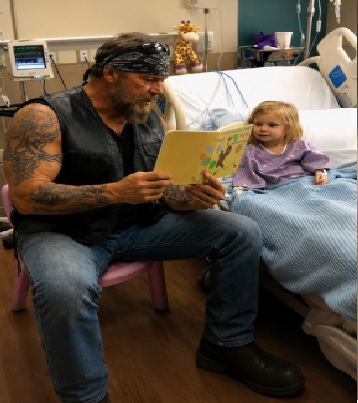
“And you look like you should be home watching cartoons instead of sitting here,” I answered with a weak smile.
She laughed quietly.
“My name is Emily. What’s yours?”
“Daniel.”
“Do you have kids?”
The question hit harder than I expected.
“No… not anymore.”
She nodded slowly, like she understood more than I had actually said. Then she scooted over and patted the empty seat beside her.
“Then maybe you could sit with me for a little while. Honestly… I’m scared to be alone.”
So I sat down.
And before I realized it, nearly three hours had passed.
She told me strange little stories about how she dreamed of seeing the ocean one day, how much she hated the green hospital Jell-O, and how adults lied to children far too often. Sometimes she laughed so brightly it almost made you forget she was sick at all. Other times she’d go completely silent and stare out the window with a sadness no child should ever carry.
Before the nurse wheeled her back to her room, she looked at me and asked:
“Will you come back tomorrow?”
I wanted to say “I don’t know.”
I wanted to keep my distance.
After losing my wife, I had promised myself I would never let anyone get close enough to destroy me again.
But instead, I heard myself say:
“Yes.”
And I came back.
Then again.
And again.
A few weeks later, I knew almost everything about her. She was eight years old. Her mother had abandoned her two years earlier. No one even knew who her father was. And the cancer had returned for the third time.
The doctors had already started losing hope.
But Emily almost never talked about death directly.
Until one night.
I found her sitting on the floor outside her room, clutching an old notebook against her chest.
“Can’t sleep?” I asked gently.
She shook her head.
“Can I ask you something weird?”
“Of course.”
She hesitated for a long moment before whispering:
“Could you be my daddy? Just for a little while?”
The air left my lungs.
I stared at her, unable to speak.
She rushed to explain.
“Not for real. I just… all the other kids here have someone. Parents call them. Visit them. Wait for them. Nobody waits for me. So I thought maybe… if someone asked, I could say I had a dad too.”
I felt something inside me begin to collapse.
Because this was exactly what I had feared most.
Getting attached.
Losing someone again.
I turned away.
“Emily… I don’t think that’s a good idea.”
The moment those words left my mouth, she lowered her eyes.
But she didn’t cry.
That somehow hurt even more.
“I understand,” she whispered.
The next day, she barely spoke to me.
A week later, her condition suddenly got worse.
The doctors stopped giving straight answers. Nurses spoke in hushed voices. The machines beside her bed beeped more often now.
Then one evening, she surprised me.
“Can you take me to the roof?” she asked quietly. “I want to see the stars.”
The wind outside was freezing. I wrapped her in my coat while she lay on the stretcher staring up at the sky.
“Pretty, isn’t it?” she whispered.
“Yeah,” I said softly. “Very.”
For a while, neither of us spoke.
Then she finally said:
“You know… I still called you my daddy in my head.”
Something inside me shattered completely.
“Emily…”
“It’s okay,” she whispered. “You didn’t have to say yes. I just… when you came to see me, it felt like I mattered to someone.”
That was the moment I broke.
I dropped to my knees beside her and cried harder than I had in years.
Real crying.
The kind you can’t hide.
The kind that rips through your chest.
“I’m sorry,” was all I could manage to say.
She reached for my hand with her tiny cold fingers.
“Don’t cry,” she whispered. “It scares me more when adults pretend everything is okay.”
I stayed with her that night.
And the next one too.
On the third day, the doctors quietly told me there wasn’t much time left.
The room felt unbearably silent.
Too white.
Too unfair.
Emily barely opened her eyes anymore.
But when I held her hand, she whispered weakly:
“Are you here?”
For the first time, she didn’t call me Daniel.
Not “sir.”
Not “mister.”
Just that.
As if she had already made the decision for both of us long ago.
I closed my eyes.
And finally realized I couldn’t keep running from pain forever.
Because love always makes us vulnerable.
But it’s also the only thing that makes us truly alive.
I leaned close to her and said through tears:
“Yes, sweetheart… Daddy’s here.”
A tiny smile appeared on her face.
The softest smile I had ever seen.
A few hours later, she was gone.
And I sat beside her for a long time afterward, still holding her hand, terrified that if I let go, I would lose the last thing that had made me feel human again.
The next morning, one of the nurses handed me the old notebook Emily had carried everywhere.
Inside were dozens of drawings.
Almost every single one showed the same thing:
A little girl and a man.
Sometimes they were eating ice cream.
Sometimes they were standing beside the ocean.
Sometimes they were simply holding hands.
And on the final page, written in shaky childish handwriting, were the words:
“Even if he wasn’t my daddy by blood… my heart still chose him.”