For most of my childhood, I believed there were no real secrets in our house.
My parents had been married for nearly thirty years. They argued occasionally, usually about ordinary things such as bills, unfinished repairs, or whose turn it was to buy groceries. But there had never been anything that made me question the life we had built together.
My father, Daniel, was the quiet one in the family. He worked with his hands, repaired almost anything that broke, and kept his personal belongings with almost obsessive precision. His desk was the clearest example.
It stood against the wall of a small room at the back of the house. The top was usually covered with notebooks, receipts and tools, but the drawers were different. Everything inside them had its place.
My mother rarely touched them.
Until one rainy Saturday afternoon.
A discovery that made no sense
My father had gone out that morning to help an old friend repair a car. My mother decided to clean the room while he was away.
I was visiting my parents that weekend, so she persuaded me to help.
At first, there was nothing unusual. We threw away old receipts, sorted papers and wiped years of dust from the corners of the desk.
Then my mother opened the lowest drawer.
It appeared to be empty except for several instruction manuals. She removed them, intending to clean underneath, and suddenly stopped.
There was something beneath the thin wooden panel at the bottom.
“What is that?” I asked.
She lifted the panel carefully.
Hidden underneath was a small package wrapped in an old piece of cloth.
My mother looked at me before opening it.
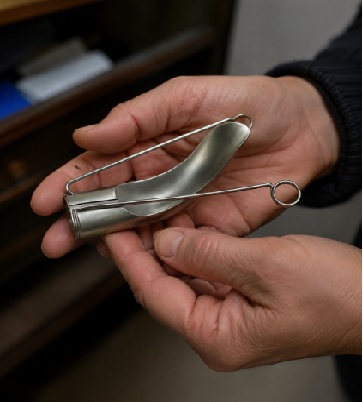
Inside was a strange metal object.
It was about the size of her palm, darkened with age and surprisingly heavy. One end was rounded, while the other contained a narrow opening and several tiny mechanical parts. There were scratches along its surface, suggesting that it had once been used frequently.
Neither of us recognized it.
My mother turned it over.
There were letters engraved on the back.
Most were too worn to read, but a date was still visible.
It was more than thirty years old.
My mother became unusually quiet.
“Why would your father hide this?”
I had no answer.
The object itself was mysterious, but what bothered us more was where we had found it. My father could have kept it openly with his tools. Instead, he had placed it beneath a false bottom in a drawer nobody was supposed to examine.
That required intention.
The second thing hidden beneath the panel
I suggested putting everything back and asking my father when he returned.
My mother didn’t respond.
She was still examining the compartment.
Then she reached inside again.
There was something else.
An envelope.
Unlike the metal object, the envelope looked relatively new. My father’s handwriting was on the front, but there was no address.
Inside were several photographs and a folded sheet of paper.
The photographs appeared much older than the envelope.
In one, my father was standing beside three young men we had never seen before. He looked perhaps twenty years old. Behind them was an industrial building surrounded by fencing.
Another photograph showed the same men beside a vehicle.
The third was different.
My father stood next to a young woman.
On the back someone had written a first name and a year.
My mother stared at the picture for a long time.
She knew almost everything about my father’s life after they met. But she knew very little about the years immediately before that.
Whenever she had asked about them, he had given the same explanation: he had traveled, taken temporary jobs and eventually returned home.
Nothing particularly interesting.
Suddenly that explanation felt incomplete.
My mother unfolded the paper from the envelope.
It wasn’t a letter.
It was a list of names.
Some had been crossed out. Beside others were dates. At the bottom was an address in a town several hours away.
Then we heard a car outside.
My father was home.
The moment he saw what we had found
The front door opened.
Normally, my father called out when he entered the house. This time he walked directly toward the back room, probably because he heard us talking.
He appeared in the doorway and smiled.
Then he noticed the desk.
His eyes moved from the open drawer to the photographs.
Finally, he saw the metal object in my mother’s hand.
His expression changed immediately.
He didn’t shout.
He didn’t demand to know why we had searched his belongings.
Instead, he closed the door behind him.
That frightened me more than anger would have.
“Where did you find that?” he asked.
My mother pointed toward the drawer.
“You know exactly where.”
For several seconds nobody spoke.
Then my mother placed the object on the desk.
“I want to know what this is.”
My father sat down.
He looked older than he had that morning.
“You should have asked me before opening that compartment.”
“And would you have told me?”
He didn’t answer.
My mother picked up the photograph of the young woman.
“Who is she?”
My father’s face tightened.
He looked at the photograph, then at me.
Finally, he said something neither of us expected.
“She died because of what happened that night.”
A life before the life we knew
My father explained that, when he was young, he had worked for a small company that repaired specialized industrial equipment.
The work required frequent travel. He and several other employees sometimes spent weeks away from home.
The men in the photographs had been his colleagues.
The metal object was a component from one of the machines they serviced.
But it wasn’t valuable.
It wasn’t even particularly rare.
Its importance came from what it represented.
Years earlier, an accident had occurred at one of the facilities where my father and his colleagues were working. A mechanical failure triggered a chain of events that caused severe damage.
The young woman in the photograph had also been working there.
She did not survive.
My father did.
For decades, he had carried the memory of that night without telling his family.
My mother listened silently.
Then she asked the question that seemed unavoidable.
“Why keep that piece of metal?”
My father looked down at it.
“Because I wanted to remember.”
But that explanation wasn’t enough.
People keep photographs to remember. They keep letters, watches, rings and other personal objects.
They do not usually hide damaged machine parts beneath false panels.
There had to be more.
My mother pointed toward the list of names.
“And what about this?”
That was when my father admitted that the story had never truly ended.
Why the names mattered
After the accident, an investigation had taken place.
According to my father, there had been disagreements about responsibility. Some believed the failure had been unavoidable. Others thought warning signs had been ignored.
My father had spent years wondering whether something could have been done differently.
The names belonged to people connected to that period of his life.
Some were former colleagues. Others were individuals he had tried to contact much later.
The crossed-out names belonged to people who had died.
The address at the bottom belonged to the last person on the list whom he had never visited.
My mother looked stunned.
“You’ve been looking for these people?”
“Not exactly.”
“Then what have you been doing?”
My father hesitated.
“Trying to understand what actually happened.”
The room fell silent again.
For years he had occasionally disappeared for a day and explained that he was visiting old friends or attending to work-related matters.
Apparently, at least some of those trips had been connected to the accident.
The secret wasn’t another family.
It wasn’t hidden money.
It wasn’t a crime he had committed.
It was an unanswered question from his youth that had followed him into middle age and then into retirement.
And he had never known how to share it with us.
Why people hide painful memories
Later, I understood something I hadn’t considered while standing beside that open drawer.
Secrecy does not always come from deception.
Sometimes it comes from shame, grief or fear.
A person can spend decades building a completely different life while still carrying one unresolved moment from the past.
Psychologists sometimes describe traumatic memories as unusually persistent because they are connected not only to facts but also to powerful emotions. Objects, sounds, locations or dates can become reminders of the original experience.
That did not automatically justify my father’s silence.
My mother had every reason to feel hurt. They had shared almost thirty years together, yet an important part of his life had remained hidden from her.
But his secrecy looked different once we understood what he had been protecting.
He had not been protecting himself from us.
He had been protecting a wound he had never learned how to discuss.
One final journey
Several days passed before anyone mentioned the address again.
Eventually, my mother placed the envelope on the kitchen table.
“If this has followed you for thirty years,” she told my father, “then finish it.”
He looked at her without speaking.
She pushed the envelope toward him.
“But you’re not going alone.”
A week later, the three of us drove to the town written on the paper.
The journey took nearly four hours.
My father barely spoke.
The address led us to a modest house on the edge of town.
An elderly man answered the door.
For a moment, he simply stared at my father.
Then he said his name.
My father nodded.
The man opened the door wider.
“I wondered if you would ever come.”
They talked for almost two hours.
My mother and I remained nearby, hearing only fragments of the conversation. It became clear that both men had spent years remembering the same accident from different perspectives.
Neither possessed a dramatic revelation capable of changing the past.
There was no hidden villain waiting to be exposed.
Instead, there were two aging men comparing memories and discovering how unreliable certainty can become after decades.
They agreed on some details.
They disagreed on others.
But on one point they were certain: the accident had changed both of their lives.
What remained after the secret was gone
When we returned home, my father opened the bottom drawer himself.
He removed the false panel and took out the metal object.
For the first time, he explained every photograph to us. He told us who the people were, what jobs they had performed and what he remembered about them.
My mother asked questions.
Some were difficult.
He answered them anyway.
The metal object was never returned to its hiding place.
For a while it remained on his desk.
Eventually, my father placed it in a small box together with the photographs and documents. The box went onto an ordinary shelf.
Nothing was hidden anymore.
That seemingly insignificant change stayed with me.
The mysterious object had frightened us because we had no context for it. In our imagination, it could represent almost anything.
Once the truth was known, it became what it had always been: a damaged piece of metal connected to a painful chapter in one man’s life.
The real discovery wasn’t inside my father’s drawer.
It was the realization that even the people closest to us can carry entire chapters of their lives in silence.
Families often assume that intimacy means knowing everything about one another. It doesn’t. Every person arrives in a relationship with memories, regrets and experiences that may be difficult to explain.
The danger begins when silence becomes permanent.
My father’s secret survived for decades because he believed speaking about the past would only bring pain back into his life. Instead, keeping it hidden allowed that pain to remain unfinished.
Opening the drawer did not destroy our family.
It forced a conversation that should probably have happened many years earlier.
And in the end, the strangest thing about that old metal object was not why my father had kept it.
It was how something so small had managed to hold thirty years of silence.