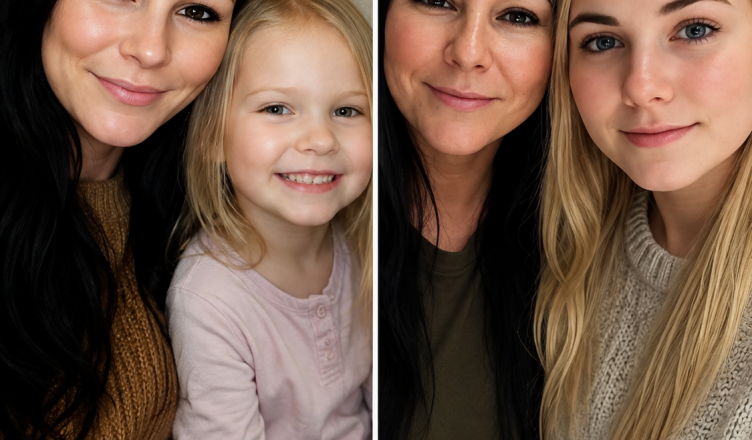
For thirteen years, I believed the most important decision of my life had already been made.
I was twenty-eight when my best friend, Claire, died unexpectedly. She left behind her five-year-old daughter, Miranda, and a silence that seemed to swallow everyone who had loved her.
Miranda’s father was not involved in her life, and there were no close relatives prepared to take responsibility for raising her. I had known Miranda since the day she was born. I had held her as a baby, bought her ridiculous birthday presents, babysat when Claire had to work late, and listened seriously as she explained childhood drawings that looked more like colorful storms.
But knowing a child and becoming responsible for that child’s entire life are two very different things.
When the possibility of adopting Miranda was first mentioned, I was terrified.
I had never planned to become a mother at twenty-eight. My apartment was small. My career was only beginning to take shape. I had some savings, but nowhere near enough to make me feel completely secure.
And I was grieving Claire too.
Yet every practical concern seemed insignificant whenever I looked at Miranda.
She had lost the person around whom her entire little world had revolved.
So I said yes.
The paperwork took time, and adjusting emotionally to our new reality took even longer. Gradually, however, Miranda became my daughter in every sense that truly mattered.
I never asked her to call me Mom.
At first, she called me by my name. A couple of years later, she occasionally began calling me Mom on her own. Eventually, it happened so naturally that neither of us noticed exactly when it became normal.
I never tried to replace Claire either.
Her photographs remained around our home. On Miranda’s birthdays, we sometimes talked about things her biological mother had done when she was little. I kept a box containing photographs, letters, and small personal belongings that had belonged to Claire, knowing Miranda might want them one day.
My greatest fear was that she would grow up believing the entire world had once abandoned her.
So I tried to make one thing absolutely clear.
She was wanted.
She was not a burden I had accepted simply because nobody else would.
She was my family.
The years passed in the ordinary way they do when you’re raising a child.
There were school projects somehow always left until the last evening, forgotten lunches, parent-teacher meetings, arguments about curfews, and birthday wishes that became increasingly expensive with every passing year.
There were scraped knees and childhood illnesses.
Then adolescence arrived.
For a while, Miranda seemed to believe that every question I asked was an attempt to control her life.
“Where are you going?”
“Why do you need to know?”
“What time will you be home?”
“Why don’t you trust me?”
Sometimes, after conversations like those, I would close my bedroom door and laugh because I could almost hear Claire’s voice saying:
“Now you understand.”
But there were genuinely difficult moments too.
When Miranda was fourteen, she suddenly wanted to know everything about what had happened after her mother’s death.
She wanted documents.
Dates.
She wanted to know who had been contacted, who had declined to take her in, and why I had eventually become first her guardian and then her adoptive mother.
I answered as carefully as I could.
I didn’t want to turn her relatives into villains. People make complicated decisions in the aftermath of tragedy, and some of them had legitimate reasons for believing they were unable to raise a five-year-old child.
But Miranda understood the central truth.
When her old life collapsed, I stayed.
After that conversation, she hugged me a little tighter and longer than usual.
Then, like any teenager, she immediately changed the subject and asked what we were having for dinner.
By the time she was seventeen, our relationship felt so solid that I had almost stopped wondering whether adoption had created some invisible boundary between us.
Miranda was preparing for university. She worked weekends at a café. She complained about my music, while I tried to understand why every drinking glass in the kitchen gradually migrated into her bedroom.
It was ordinary life.
And once, ordinary life was exactly what I had wanted most for her.
Then Miranda turned eighteen.
We had a small celebration at home. Several of her friends came over, we ordered far too much food, and someone brought a cake large enough to feed thirty people.
Late that evening, after everyone had left, Miranda hugged me.
“Thank you,” she said.
“For the party?”
“For everything.”
I assumed she was simply emotional because it was such an important birthday.
Three days later, Miranda appeared in my bedroom doorway.
I was sitting on the bed sorting laundry when I noticed her standing there.
Something about her expression immediately made me nervous.
She wasn’t angry.
Anger probably would have frightened me less.
She looked determined.
“Can we talk?” she asked.
“Of course.”
She stepped inside but didn’t sit down.
Then she said something that made my stomach tighten.
“I’m legally an adult now.”
I looked at her.
“Yes.”
“So there are decisions I can make for myself.”
My mind immediately raced through possibilities.
Had she decided not to attend university?
Was she planning to move in with someone?
Had something happened at work?
“Miranda, what is this about?”
She pulled an envelope from behind her back.
For several seconds, she simply held it.
Then she handed it to me.
“I’ve been working on something.”
Inside were several printed pages.
I began reading, expecting something terrible.
Instead, I became confused.
The documents concerned her name.
More specifically, Miranda’s legal name.
After the adoption, she had kept Claire’s surname. I had insisted on it. Her name was part of her history, and I had never wanted her new family to erase the memory of the woman who had given birth to her.
But the papers Miranda had placed in my hands concerned an official name change.
She wanted to add my surname to hers.
I looked up at her.
“I don’t understand.”
Finally, she sat beside me.
“You always told me that becoming your daughter didn’t mean I stopped being my biological mother’s daughter.”
I nodded.
“And you were right. I don’t want to give up her name.”
She was silent for a moment.
“But I don’t want to go through the rest of my life without yours either.”
I couldn’t speak.
For all those years, there had been a fear buried somewhere deep inside me that I almost never discussed.
That one day Miranda would become an adult and decide that our relationship had simply been part of her childhood.
Legally, she no longer needed me.
She could leave.
She could build a completely independent life.
Perhaps that fear was irrational. But adoption can contain a strange contradiction: for years, you teach a child that love and family are permanent while knowing that, as an adult, they have every right to decide for themselves who they consider family.
It turned out Miranda understood far more than I had realized.
“When I was little,” she continued, “you chose me because I couldn’t choose anything for myself.”
She looked down at the documents.
“Now I can.”
That was when I started crying.
Not quietly or gracefully like people do in movies.
I cried so hard that Miranda started laughing while she hugged me.
“This wasn’t supposed to make you hysterical,” she said.
“You could have warned me.”
“That would have ruined the surprise.”
We sat together for a long time.
Finally, I asked the question that wouldn’t leave my mind.
“Are you absolutely sure?”
She nodded.
“I’ve been thinking about it for almost a year.”
That surprised me more than anything.
This wasn’t an impulsive decision inspired by her eighteenth birthday. Miranda had researched the process in advance and spent months considering what the change would mean to her.
We talked about Claire.
That conversation mattered deeply to me.
I told Miranda once again that she owed me nothing for raising her. Adoption was not a loan a child had to repay with gratitude, loyalty, or a surname.
She understood.
“That’s not why I’m doing it,” she said.
And I believed her.
She wanted to carry two surnames because both belonged to her story.
One represented where she came from.
The other represented the home where she had grown up.
Neither needed to erase the other.
Something changed inside me at that moment too.
For years, I had thought about my relationship with Miranda primarily in terms of responsibility.
After Claire died, a little girl needed an adult.
I became that adult.
I cooked meals, attended parent-teacher meetings, paid bills, established rules, worried about grades, and sat beside her bed whenever she was sick.
Those things were motherhood.
But now I understood that I hadn’t become a mother simply on the day I signed the adoption papers.
It happened afterward, thousands of times.
When I got out of bed because she’d had a nightmare.
When I listened to her fears.
When I said no even though saying yes would have been easier.
When I apologized because I realized I had been wrong.
When I gave her freedom despite wanting to protect her from everything in the world.
When I reminded myself that loving Claire’s daughter meant allowing Miranda to remember her biological mother rather than trying to compete with a woman who was no longer alive.
And perhaps the hardest lesson was something else entirely.
Children eventually become adults.
And then they get to decide for themselves what the word “family” means.
Several months later, Miranda’s new documents arrived.
She carried the envelope into the kitchen and opened it at the table.
There was her first name.
And after it, two surnames.
Claire’s.
And mine.
Miranda stared at the document silently for several seconds before smiling.
“It looks strange.”
“You can still change your mind.”
She gave me the familiar irritated look of a teenager.
“Mom.”
That one word was enough.
Once, I thought I had rescued a five-year-old girl from being alone.
Years later, I understood that the truth was far more complicated.
Miranda had changed my life just as much as I had changed hers.
I had believed adulthood would inevitably weaken the connection between us. Instead, her eighteenth birthday helped me understand something I should have realized long before.
A legal document can officially make people a family.
But it cannot create genuine closeness.
That happens afterward.
It happens in kitchens and school hallways. During arguments and celebrations. Through disappointment, forgiveness, everyday responsibilities, and years spent beside one another.
Thirteen years earlier, I had been the adult, while Miranda was a five-year-old child who had no control over what would happen to her life next.
At eighteen, the choice finally belonged entirely to her.
And she chose to carry both parts of her life forward.
Not because the past needed to be replaced.
But because her family had become stronger and larger than the tragedy that had once nearly left a little girl completely alone.