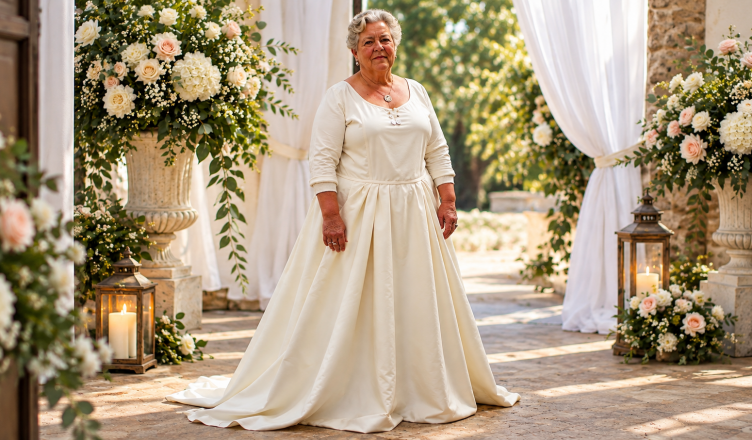
At sixty-five, Margaret had stopped expecting life to surprise her.
She had already experienced the kind of love people hope will last forever. For more than three decades, she had shared her life with her husband, raised a family beside him, celebrated ordinary victories, survived difficult years, and grown accustomed to the quiet comfort of having someone who knew her better than anyone else.
Then, ten years earlier, he died.
Grief did not disappear quickly. For a long time, Margaret could not imagine allowing another man into the space her husband had occupied. Friends occasionally encouraged her to meet people, but she politely changed the subject. She wasn’t angry with love. She simply believed that chapter of her life had ended.
She was wrong.
An Unexpected Second Beginning
Margaret met Henry almost by accident at a community event. He was close to her age, soft-spoken, patient, and completely uninterested in pretending to be younger than he was.
Their relationship developed slowly.
There were no dramatic declarations in the beginning. They had coffee. Then dinner. They took walks, talked about books and family, and discovered that silence between them could be comfortable rather than awkward.
Henry understood that Margaret’s first marriage remained an important part of her life. He never treated her memories as competition.
That mattered to her.
Gradually, companionship became affection, and affection became something neither of them expected to experience again with such intensity.
When Henry eventually asked her to marry him, Margaret said yes.
They decided against an elaborate wedding. Neither wanted hundreds of guests, expensive decorations or months of complicated planning. A modest ceremony surrounded by people they loved felt right.
But Margaret wanted one traditional thing.
A wedding dress.
Not an ordinary white outfit and not something chosen simply because it was considered «appropriate for her age.» She wanted to walk toward Henry wearing a real bridal gown.
So one bright morning, she entered a bridal boutique determined to find it.
The Visit That Changed Everything
Rows of ivory and white dresses surrounded her as she stepped inside. Lace sleeves, long trains and delicate fabrics hung beneath warm lights.
For a moment, Margaret felt unexpectedly nervous.
Buying a wedding dress at sixty-five was different from doing it at twenty-five. She knew people might be surprised. She was prepared for questions.
What she did not expect was ridicule.
Two young saleswomen stood behind the counter talking. When Margaret explained that she was getting married and wanted to try several gowns, their expressions changed.
One looked at the other.
Then came a quiet laugh.
At first Margaret wondered whether she had misunderstood. But the remarks that followed left little room for doubt.
The women suggested that some of the dresses were designed for much younger brides. One implied that Margaret might be more comfortable looking at simpler formalwear instead.
Another joked about whether she really needed the full bridal experience.
Margaret felt the excitement she had carried into the store disappear.
The humiliation was especially painful because the occasion was so personal. She had not entered the boutique asking anyone’s permission to marry. She had come as a customer looking for a dress for one of the happiest days of her life.
Yet suddenly she was being treated as though wanting to look beautiful were somehow embarrassing because of the year printed on her birth certificate.
She considered leaving.
Then someone tapped one of the saleswomen on the shoulder.
The conversation stopped.
The Person Standing Behind Them
The woman behind the employees had heard enough.
She was the boutique manager.
She calmly asked what was happening. Neither employee seemed eager to explain, so Margaret did.
She did not exaggerate. She simply described what had been said and explained why she had come to the shop.
The manager’s expression became serious.
She reminded the employees that their job was not to determine who deserved to feel like a bride. Their responsibility was to help customers find clothing that made them feel confident and comfortable.
A bride’s age, she said, was irrelevant to the respect she should receive.
The store became silent.
The manager then turned toward Margaret and apologized.
She offered to personally help her search for a gown.
Margaret hesitated.
Part of her wanted to walk out and never return. But doing so would mean allowing someone else’s cruelty to decide how this important morning ended.
She stayed.
Finding the Dress
The first gown wasn’t right.
Neither was the second.
One felt too heavy, another didn’t fit comfortably around the shoulders, and a third looked beautiful on the hanger but somehow wrong once Margaret put it on.
The manager never rushed her.
Eventually, she brought another dress from a different section of the boutique.
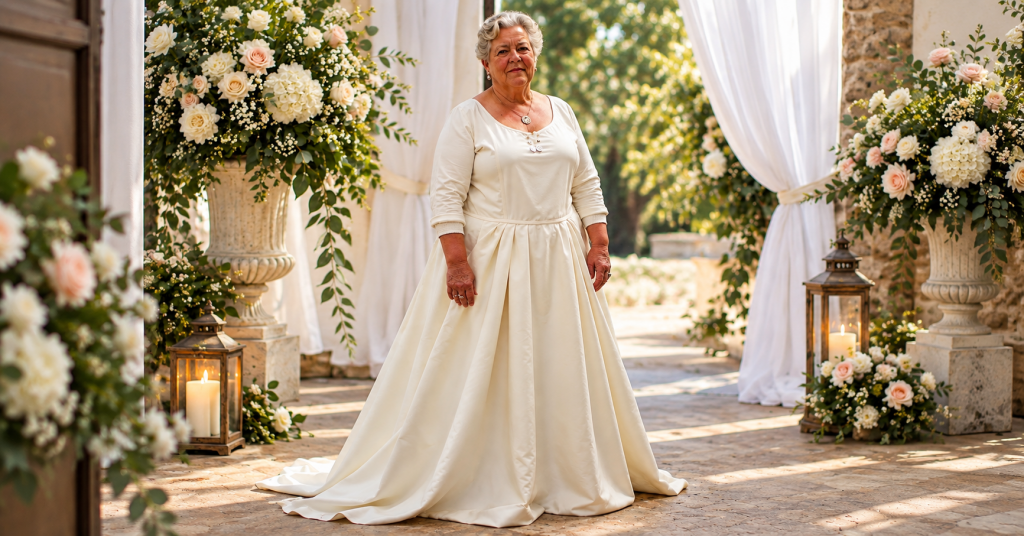
It was elegant without being extravagant, with a flattering silhouette and delicate details that caught the light without overwhelming the design.
Margaret stepped into it.
When she looked in the mirror, something changed.
For several seconds she said nothing.
The reflection looking back at her was not a woman trying to imitate a twenty-year-old bride. Nor was it someone attempting to erase the years she had lived.
She saw herself.
Sixty-five years old. A widow. A woman who had known enormous happiness and painful loss. Someone who had spent years believing romantic love belonged entirely to her past.
And now she was a bride again.
She smiled.
«This is the one,» she said.
The manager smiled back.
Why Age Can Become an Unfair Boundary
Although Margaret’s story is fictionalized around a familiar social theme, the prejudice at its center is real: older adults are frequently subjected to assumptions about how they are supposed to behave, dress or pursue relationships.
Ageism does not always appear as an obvious insult. Sometimes it arrives disguised as advice.
People may be told they are «too old» for particular clothes, hobbies, careers, travel plans or romantic relationships. Expectations can become especially restrictive for older women, whose appearance is often judged according to contradictory standards.
The problem with these assumptions is that aging does not erase individuality.
There is no universal age at which someone stops caring about beauty, companionship, celebration or romance. People do not become identical simply because they enter their sixties, seventies or eighties.
Preferences remain personal.
So does love.
Love After Loss Is Not Replacement
Margaret also struggled privately with another question before accepting Henry’s proposal.
Did loving someone new somehow diminish the marriage she had shared with her late husband?
Over time, she realized that it did not.
Human relationships do not need to cancel one another out. A person can treasure a spouse who died while still building a meaningful relationship with someone else years later.
The past remains part of a person’s identity, but it does not have to become a prison.
For Margaret, marrying Henry was not an attempt to recreate her first marriage. Henry was a different person, and their relationship had developed during a completely different stage of life.
That was precisely why it mattered.
She was not returning to an earlier version of herself.
She was moving forward.
The Wedding Day
Several weeks later, Margaret stood in front of a mirror while preparing for the ceremony.
The dress fit perfectly.
She remembered the uncomfortable moment in the boutique, but it no longer dominated the memory. What remained instead was the moment she had chosen not to walk away.
When the ceremony began, Henry waited for her at the front of the room.
The celebration was exactly what they had wanted: intimate, warm and uncomplicated.
There was no attempt to make their wedding resemble that of a young couple beginning adulthood together.
Margaret and Henry were not beginning life.
They were beginning another part of lives already filled with experiences, families, mistakes, memories and losses.
Perhaps that made their promises even more meaningful.
They knew that time was valuable.
They knew relationships required patience.
And they understood that happiness should not be postponed simply because society sometimes expects older people to quietly step away from experiences associated with youth.
No Expiration Date on Joy
A wedding dress is ultimately just fabric. But what it represented to Margaret was far more important.
She wanted the freedom to celebrate her marriage on her own terms.
That desire did not become ridiculous when she turned sixty-five.
Growing older inevitably changes people. Bodies change, priorities shift, families evolve, and opportunities sometimes narrow. Pretending otherwise would be unrealistic.
But age also brings experience, perspective and a clearer understanding that other people’s approval is not always worth pursuing.
Margaret had already lost someone she loved and rebuilt a life after grief. She understood how suddenly circumstances could change.
She wasn’t willing to surrender happiness merely because strangers believed it had arrived too late.
Standing beside Henry in the dress she had chosen, she no longer cared what two saleswomen had thought when she first entered the boutique.
She had found something far more valuable than their approval.
She had found another reason to look toward the future.