Preparing chicken for dinner is usually an ordinary task. You open the package, season the meat and start cooking. But occasionally, a chicken breast looks so unusual that it raises an immediate question: is there something wrong with it?
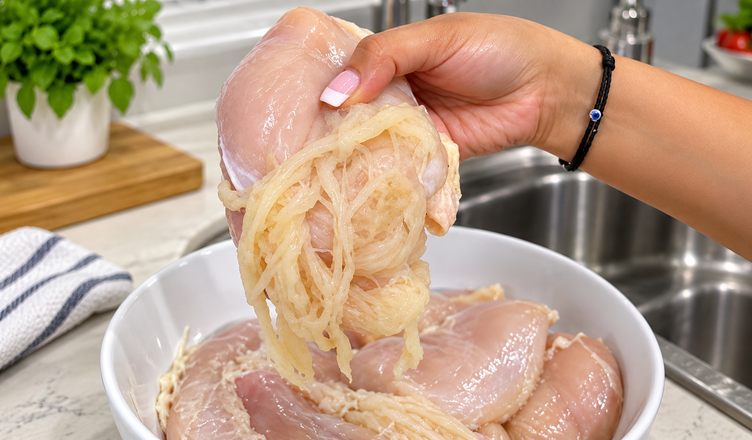
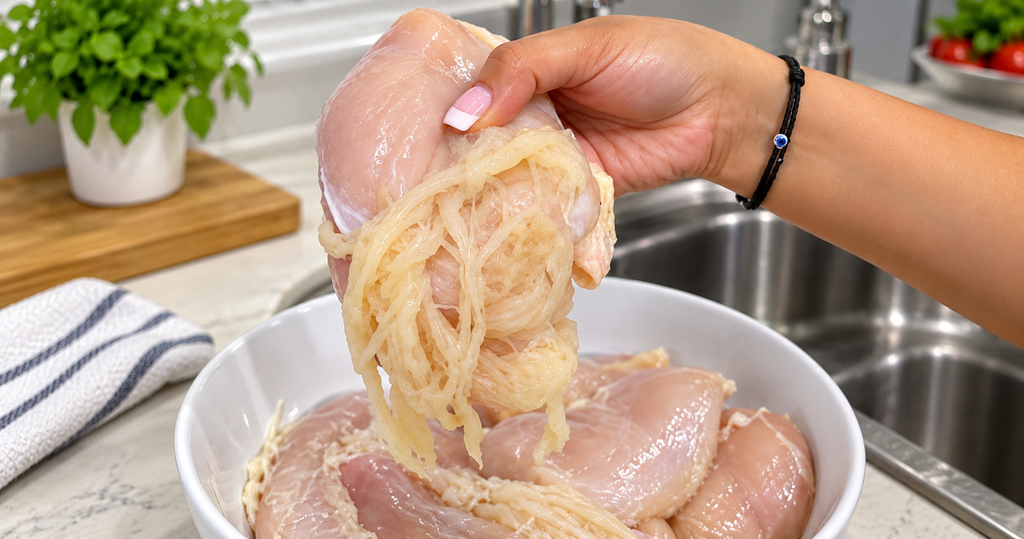
Imagine picking up a raw chicken breast and noticing that the surface does not appear firm and smooth. Instead, the muscle seems to separate into thin strands. With very little pressure, the meat begins pulling apart along its fibers, almost as though it has already been shredded.
It can look alarming, particularly when the chicken is fresh and has not yet been cooked. Yet an unusual texture does not automatically mean that the meat is spoiled. Several different factors can change the structure of chicken breast, ranging from natural muscle characteristics and modern poultry production to freezing, storage conditions and actual deterioration.
Understanding the differences can help consumers decide when unusual chicken is merely a quality issue and when it belongs in the trash.
Chicken Breast Is Made of Muscle Fibers
What we call chicken breast is skeletal muscle. It consists of bundles of muscle fibers surrounded by connective tissue. Normally, these structures remain tightly organized, which is why a fresh chicken breast feels relatively firm and holds together when it is handled.
Those fibers become particularly obvious when cooked chicken is pulled apart with a fork. Raw meat, however, generally should not disintegrate easily under normal handling.
If the internal structure of the muscle has been altered, the bundles may become much more visible. The breast can develop gaps, grooves or sections that resemble strings. In more pronounced cases, the meat may separate along these lines.
That appearance can have several possible explanations.
A Quality Condition Known as “Spaghetti Meat”
One phenomenon documented by poultry scientists is commonly called “spaghetti meat.” The informal name describes the unusual appearance of affected chicken breast: muscle-fiber bundles can separate from one another and create a loose, string-like structure.
This condition has been studied particularly in modern broiler chickens bred for efficient growth and high breast-meat yield. Researchers have investigated how extremely rapid muscle development may affect the microscopic structure of breast tissue.
Muscle growth requires an adequate supply of oxygen and nutrients. When breast muscles become very large over a relatively short period, normal tissue development and repair may be affected. Changes can occur in muscle fibers and the connective tissue that normally helps hold them together.
The result may be meat that is noticeably softer and less cohesive than consumers expect.
Importantly, the term describes a muscle abnormality and quality problem. Its appearance alone is not evidence that the chicken contains worms or some mysterious foreign material. The “strings” may simply be portions of the muscle itself becoming unusually easy to distinguish.
Other breast-muscle conditions have also been identified in commercial poultry, including abnormalities often referred to as woody breast and white striping. These conditions are not identical, although researchers have studied them in connection with changes associated with rapid muscle growth.
Could Freezing Also Change the Texture?
Yes. Not every chicken breast that separates easily necessarily has a growth-related muscle abnormality.
Freezing can alter the physical structure of meat. Because muscle contains a large amount of water, ice crystals form when meat freezes. Those crystals can damage cells and affect the organization of the tissue.
How much damage occurs depends partly on the freezing and thawing process. Repeated temperature changes can be particularly harmful to texture.
After thawing, damaged meat may release more liquid than expected and feel softer. Its fibers can become easier to separate. A product that was frozen somewhere during processing or distribution may therefore have a different texture from chicken that has remained consistently refrigerated.
This does not automatically make the meat unsafe. It does, however, illustrate why appearance alone cannot provide a complete diagnosis.
Texture and Food Safety Are Different Questions
This distinction is crucial.
A chicken breast can have poor texture without necessarily being spoiled. Conversely, chicken can carry harmful microorganisms while looking completely ordinary.
Consumers sometimes rely on appearance or smell as if either were a perfect food-safety test. They are not.
Obvious signs of spoilage should certainly be taken seriously. A strong unpleasant or abnormal odor, unusual sliminess, major discoloration combined with other signs of deterioration, damaged packaging or uncertainty about how long the chicken has remained warm are all reasons for caution.
But the absence of those warning signs does not prove that raw poultry is free of pathogens.
Raw chicken should always be treated as a product capable of carrying harmful bacteria. Safe storage, prevention of cross-contamination and thorough cooking matter regardless of whether the breast looks perfectly normal.
Don’t Wash Raw Chicken
Seeing strange fibers may tempt someone to put the chicken under the faucet and wash it before deciding what to do.
That is not a good solution.
Washing raw poultry does not reliably make it safer. Instead, water striking the surface can spread contaminated droplets around the sink and nearby kitchen surfaces. Those droplets can reach utensils, countertops or other foods.
Cooking is the important safety step.
Keep raw chicken separated from foods that will be eaten without further cooking. After handling it, wash hands thoroughly with soap and water and clean surfaces or utensils that have contacted the raw meat.
A separate cutting board for raw meat can also make cross-contamination easier to control.
Temperature Matters More Than Color
Another common mistake is deciding whether chicken is cooked simply by looking at its color.
Chicken may appear white inside before every part has reached a safe temperature, while other factors can occasionally influence the color of fully cooked meat. A food thermometer provides much more useful information.
For chicken and other poultry, the widely recommended minimum internal temperature is 165°F, or approximately 74°C. The thermometer should be inserted into the thickest part of the breast while avoiding misleading contact with bone when applicable.
Once the appropriate internal temperature has been reached, proper cooking greatly reduces the risk from common foodborne pathogens.
That principle applies whether the chicken breast has an unusual muscular texture or looks completely conventional.
When Should You Throw the Chicken Away?
There is an important difference between being able to explain an unusual appearance and being able to guarantee the condition of one particular package of meat.
Without examining the product and knowing its complete storage history, nobody can determine with certainty why an individual chicken breast is falling apart.
If the chicken has a clearly unpleasant odor, feels abnormally sticky or slimy, has been stored improperly, is beyond a safe storage period or was left at unsafe temperatures, discarding it is the sensible choice.
The same applies when the packaging is leaking, swollen or otherwise compromised.
And if the appearance is so abnormal that you simply cannot determine whether deterioration has occurred, replacing the chicken may be preferable to taking an unnecessary risk. The cost of one package of meat is small compared with the consequences of foodborne illness.
If a newly purchased product appears seriously abnormal despite being within date and properly refrigerated, photographing it and contacting the retailer or producer can also be useful. Keeping the packaging allows the company to identify information such as the lot or production code.
Why Consumers Are Seeing These Changes
The broader issue extends beyond one strange-looking chicken breast.
Over many decades, poultry production has become increasingly efficient. Chickens raised for meat can reach market size rapidly, and selective breeding has produced birds with substantially developed breast muscles. These changes have helped make chicken widely available and relatively affordable.
But biological systems have limits.
Scientists studying modern poultry have examined the relationship between rapid growth, breast size, circulation, muscle metabolism and structural abnormalities. Conditions affecting meat texture have therefore become an important subject not only for consumers but also for farmers, processors, animal scientists and the poultry industry.
For shoppers, the most visible consequence may simply be a chicken breast that feels unusually hard, contains noticeable white lines or separates into soft strands.
That does not mean every unusual chicken breast has the same underlying condition. Processing, freezing and storage can produce their own changes, which is why identifying the cause from a photograph or brief description alone is difficult.
What to Check Before Cooking
When opening a package of raw chicken, consider the entire condition of the product rather than focusing on one unusual feature.
Check whether the package was properly sealed and whether the chicken has remained adequately refrigerated. Pay attention to the use-by or sell-by information while remembering that dates do not replace proper storage.
Notice any major changes in smell or texture. Some liquid inside packaged poultry can be normal, but obviously abnormal odor or deterioration should not be ignored.
If the meat merely has clearly separated muscle fibers while everything else about its storage and condition appears normal, a muscle-quality abnormality or processing-related texture change may be one possible explanation. It is not possible, however, to diagnose the exact cause solely from the fact that the breast looks stringy.
Whatever its appearance, handle it as raw poultry and cook it properly.
An Unpleasant Appearance Is Not a Diagnosis
Finding a chicken breast that seems to unravel into strands can understandably be disturbing. Food is something we trust enough to put into our bodies, so unexpected changes naturally attract attention.
Fortunately, visible fibers do not automatically point to something sinister. Chicken breast is muscle, and changes to the organization of that muscle can produce surprisingly dramatic textures. Documented poultry conditions such as spaghetti meat provide one possible explanation, while freezing, thawing and other processing or storage factors can also affect the structure.
The most important lesson is to separate food quality from food safety.
A strange texture may indicate a quality defect without proving that the chicken is dangerous. At the same time, perfectly normal-looking poultry still requires careful handling and thorough cooking.
When there are genuine signs of spoilage or uncertainty about storage, throwing the meat away is the safer decision. When the concern is primarily an unusual fibrous structure, the explanation may lie in the biology of the chicken muscle rather than in contamination.
Either way, good kitchen practices remain the best protection: keep raw poultry cold, avoid washing it, prevent cross-contamination and cook it to an internal temperature of at least 165°F (74°C).