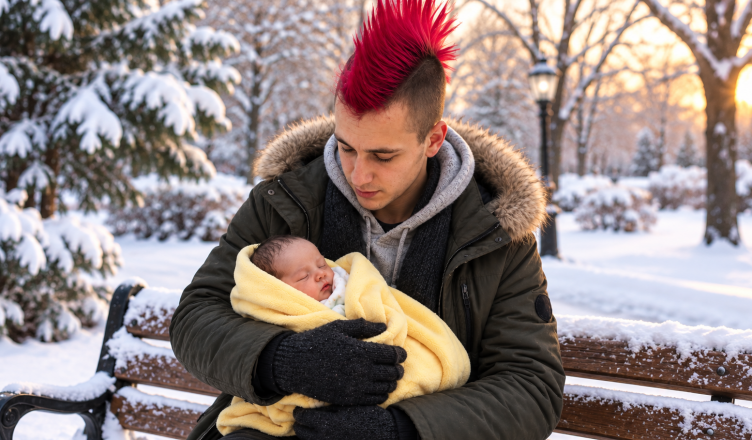
People had been judging my son long before they ever bothered to know him.
At sixteen, Ryan had developed a style that made him impossible to overlook. His hair was shaved on both sides and dyed bright pink down the middle. He wore heavy boots, a battered leather jacket covered with patches, and several piercings in his ears and eyebrow.
To strangers, those details seemed to tell them everything they needed to know.
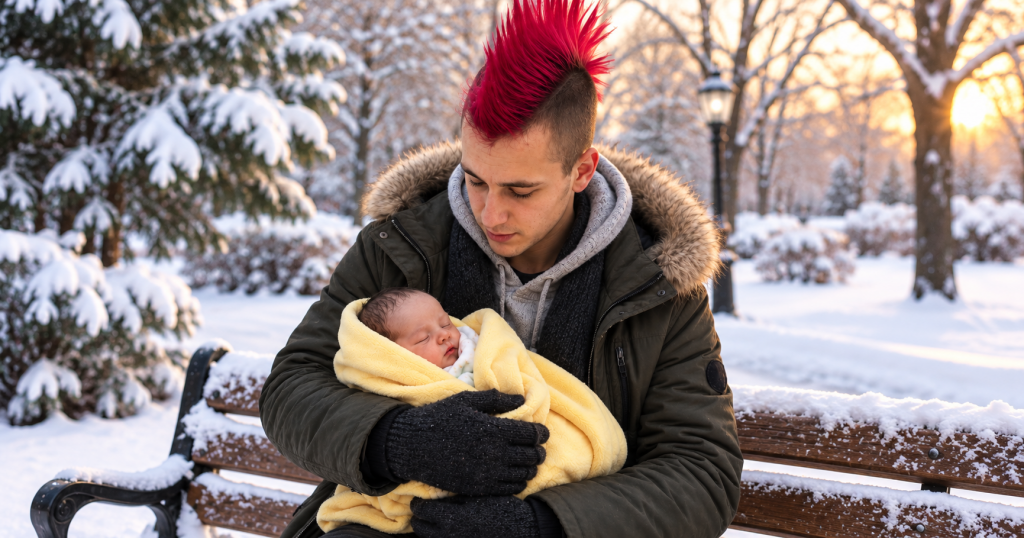
Parents sometimes watched him carefully when he walked past younger children. Cashiers followed him with their eyes in stores. At school, teachers occasionally assumed he was responsible whenever something went wrong, even before anyone had explained what had happened.
I won’t pretend Ryan was an easy teenager. He could be stubborn. His bedroom looked as though a small tornado lived there. He played music much louder than necessary and had perfected the teenage art of answering a perfectly reasonable question with a single word.
But I knew another side of him.
He was the boy who carried injured birds home in cardboard boxes. He quietly shoveled snow from our elderly neighbor’s steps without telling anyone. When his little cousin became frightened during a thunderstorm, Ryan sat beside him for nearly an hour, pretending not to notice when the child grabbed his hand.
Still, appearances are powerful.
And one winter night, Ryan discovered just how wrong appearances could be.
A Cry in the Cold
It was shortly after midnight when I realized he wasn’t home.
Snow had started falling earlier that evening, and the temperature had dropped sharply. Ryan had gone to meet two friends and promised to return before eleven.
By midnight, I was angry.
By twelve-thirty, I was frightened.
I called him repeatedly. No answer.
Then, at 12:47, my phone finally rang.
«Mom?»
Something in his voice made me stand immediately.
He wasn’t joking or annoyed. He sounded terrified.
«I found a baby.»
For several seconds, I thought I had misunderstood him.
«A what?»
«A baby. A real baby. He’s outside.»
Ryan had been walking home through a quiet residential street when he heard something strange near a row of garages. At first, he thought it was an animal. Then he heard the sound again.
Crying.
He followed it toward a sheltered doorway and discovered a small bundle partly hidden behind several cardboard boxes.
Inside was a newborn.
The baby was wrapped in a thin blanket completely inadequate for the freezing night.
Ryan immediately took off his jacket, wrapped it around the child and called emergency services. Then he called me.
«Don’t move,» I told him. «I’m coming.»
But Ryan had already made one decision.
He wasn’t leaving the baby alone.
Waiting for Help
When I arrived, I saw my son sitting on the ground beneath an exterior light.
His pink hair was covered with tiny flakes of snow. He was wearing only a black T-shirt despite the cold.
The baby was against his chest beneath the leather jacket.
I will never forget that image.
Ryan was shaking almost as badly as the child, but whenever I suggested we wait somewhere warmer nearby, he refused to move until the emergency dispatcher told him it was safe.
«What if something happens?» he kept saying.
Paramedics arrived within minutes.
They took the baby, examined him and transported him to the hospital. Police officers remained behind and asked Ryan where exactly he had found the child, whether he had seen anyone nearby and whether he had touched anything else.
He answered every question.
One officer eventually told us we could go home.
Neither of us slept much.
Ryan kept asking whether the baby would survive.
I didn’t know.
The Knock at the Door
The following morning, someone knocked.
Two police officers were standing outside.
For one horrible second, every possible nightmare entered my mind.
Had the baby died?
Had Ryan accidentally done something wrong?
Was there something he hadn’t told me?
One officer asked whether they could come inside.
Ryan appeared at the top of the stairs, still wearing yesterday’s clothes.
Then the officer explained why they had returned.
The baby was alive.
Doctors believed Ryan’s quick response had been extremely important. With temperatures so low, leaving a newborn outside much longer could have had devastating consequences.
I looked at Ryan.
He said nothing.
He simply sat down on the stairs and covered his face with both hands.
The police were still investigating how the newborn had ended up outside, so they could not tell us much more. They also warned us not to speculate about who had left the child or why.
That mattered.
It would have been easy to invent a villain and build an entire story around assumptions. But we didn’t know the circumstances. There might have been fear, desperation, illness or circumstances we couldn’t possibly understand.
What we did know was simple.
A vulnerable child had been exposed to dangerous cold, and a sixteen-year-old boy had stopped to help.
The Part Nobody Expected
News traveled quickly through the neighborhood.
Suddenly, some of the same people who had crossed the street when they saw Ryan were praising him.
One neighbor called him a hero.
Ryan hated that word.
«I didn’t do anything special,» he told me. «What was I supposed to do? Walk away?»
That sentence stayed with me.
To him, helping hadn’t been heroic. It had simply been the only acceptable choice.
A few days later, I watched him leave the house wearing another black jacket. His pink mohawk was freshly dyed. The piercings were still there. The boots were still heavy enough to wake the entire house when he walked downstairs.
Nothing about his appearance had changed.
But something about the way people looked at him had.
And I found that strangely frustrating.
Why had a newborn needed to be in danger before people were willing to see kindness in my son?
Why did he have to prove his character before strangers granted him the basic courtesy of not assuming the worst?
What That Night Taught Me
We often claim that appearance doesn’t matter, yet we make judgments based on it constantly.
Clothing, hairstyles, tattoos and piercings can communicate identity, taste or membership in a particular subculture. They cannot reliably tell us whether someone is compassionate, trustworthy or courageous.
Ryan’s appearance had always been loud.
His kindness was quieter.
Maybe that was why fewer people noticed it.
The baby eventually disappeared from our lives into the privacy of medical care and official procedures. We respected that privacy. Ryan never learned much about what happened afterward, and perhaps that was appropriate. The child’s future belonged to the child, not to our curiosity.
But the night changed something in our family.
Months later, Ryan’s hair was still pink.
His music was still too loud.
His room was still a disaster.
And strangers still sometimes stared.
Whenever I noticed them doing it, though, I remembered that freezing night.
I remembered my sixteen-year-old son sitting in the snow without his jacket, holding a newborn against his chest and refusing to leave until help arrived.
People saw the mohawk first.
I knew the person underneath it.