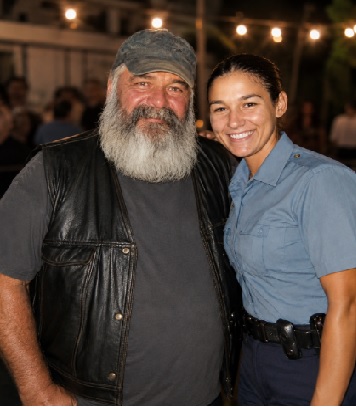
Officer Sarah Mitchell had heard almost every excuse a driver could invent.
People blamed medication, exhaustion, faulty speedometers, bad roads, arguments with spouses, malfunctioning brakes, and sometimes simple bad luck. After nine years on patrol, she had learned not to judge too quickly—but she had also learned that nervous people often lied.
The man standing beside the dark sedan was definitely nervous.
Sarah had noticed the vehicle shortly after midnight. It was moving well below the speed limit, drifting slightly toward the center line before correcting its course. Nothing dramatic, but enough to justify a stop.
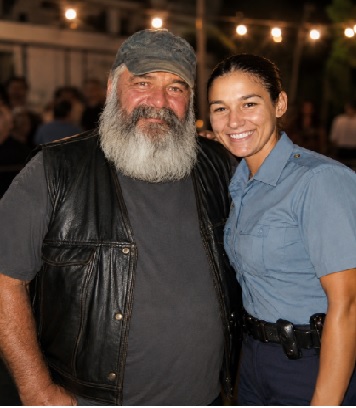
When she approached the driver’s window, the man already had both hands resting visibly on the steering wheel.
He looked to be in his early fifties. His clothes were ordinary, his car clean but old. There was no smell of alcohol. His speech wasn’t slurred. Yet something about him immediately bothered her.
He kept staring at her face.
Not at the badge.
Not at the uniform.
At her.
«License and registration, please.»
The man handed them over without protest.
His name was Daniel Harper.
«Have you been drinking tonight?»
«No.»
«Any medication?»
«No.»
«Drugs?»
«Nothing.»
Sarah studied him.
«Then why are you driving like that?»
Daniel hesitated.
«I was distracted.»
«By what?»
For several seconds, he said nothing.
Sarah’s patience disappeared.
«Don’t lie to me.»
The words came out sharper than she intended.
Something changed in Daniel’s expression. He lowered his eyes and whispered:
«I’m not lying.»
Sarah asked him to step out of the vehicle.
Nothing in the Tests Explained His Behavior
The roadside breath test registered zero.
Sarah repeated the procedure.
Again, zero.
Daniel passed the basic coordination tests as well. He wasn’t perfectly relaxed, but he showed none of the obvious signs she expected from an intoxicated driver.
That should have reassured her.
Instead, it made the situation stranger.
«Why are you shaking?» she asked.
«I’m tired.»
«That’s not the whole answer.»
Daniel looked toward her patrol car.
«No. It isn’t.»
«Then tell me.»
He remained silent.
Sarah decided to take him to the station for further examination. Daniel didn’t resist. He simply nodded and climbed into the back seat.
During the drive, he barely moved.
Sarah occasionally glanced at him through the rearview mirror. Several times she caught him watching her.
Finally she asked, «Do I know you?»
«No.»
«Have we met before?»
«No.»
«Then stop staring at me.»
«I’m sorry.»
But his voice didn’t sound embarrassed.
It sounded sad.
At the station, the mystery only deepened.
Further testing found no indication that Daniel had consumed alcohol or illegal drugs. There was no obvious medical emergency. His documents were valid, the vehicle wasn’t reported stolen, and a routine check revealed nothing that justified keeping him in custody.
A younger officer looked at Sarah.
«So what exactly did he do?»
She didn’t have a convincing answer anymore.
«He was driving erratically.»
«Maybe he’s exhausted.»
Maybe.
Yet Sarah couldn’t forget the way Daniel had looked at her.
Eventually, there was no reasonable basis to hold him.
She returned his documents.
«You’re free to go. Don’t drive if you’re too tired. Call someone or get a taxi.»
Daniel took the papers.
«Thank you.»
He walked toward the exit.
Sarah returned to her desk and tried to forget him.
Then the footsteps stopped.
She looked up.
Daniel was standing beside the door with one hand resting on the handle.
He turned around.
«Officer Mitchell?»
«What?»
«Can I ask you something?»
Sarah sighed.
«One question.»
Daniel swallowed.
«What was your mother’s maiden name?»
The room suddenly seemed silent.
Sarah stood.
«What did you say?»
Daniel didn’t repeat himself.
He didn’t need to.
A Name Almost Nobody Knew
Sarah’s mother had died when Sarah was fourteen.
Her name after marriage had been Rebecca Mitchell, but she had been born Rebecca Callahan.
Callahan.
Sarah rarely used the name. It wasn’t something colleagues knew, and it certainly wasn’t information she discussed with strangers stopped on deserted roads after midnight.
She moved away from the desk.
«How do you know anything about my mother?»
Daniel’s face lost what little color remained.
«I wasn’t sure until now.»
«Sure about what?»
He looked toward the other officers.
«Could we talk somewhere private?»
«No. You’re going to explain it right here.»
Daniel slowly reached toward the inside pocket of his jacket.
Two officers immediately reacted.
«Hands where we can see them.»
Daniel froze.
«It’s only a photograph.»
Sarah stared at him.
«Take it out slowly.»
He did.
It was an old photograph, faded along the edges and slightly bent through the middle.
Daniel placed it on the desk rather than handing it directly to her.
Sarah looked down.
The photograph showed three young people standing beside a lake. The image appeared to have been taken decades earlier.
One of them was Daniel.
Much younger, perhaps twenty.
Beside him stood another man Sarah didn’t recognize.
Between them was a smiling young woman.
Sarah stopped breathing for a moment.
She knew that face.
Her mother.
The Box in the Attic
Daniel explained that his own father had died several months earlier. While clearing the family home, Daniel had discovered a sealed cardboard box in the attic.
Inside were photographs, postcards, receipts and several letters.
Most meant nothing to him.
But one bundle was tied together with a faded blue ribbon. The letters had been written by a woman named Rebecca Callahan.
Daniel had never heard the name.
He began reading because the letters were addressed to his father.
They described a friendship that had apparently been important to both of them when they were young. Some passages suggested that Rebecca had been going through a difficult period. Others referred to decisions she was afraid to make.
But several pages were missing.
Daniel initially treated the discovery as nothing more than a forgotten piece of his father’s youth.
Then he found the photograph.
On the back, someone had written a date, Rebecca’s name and the name of a town.
Years later, curiosity brought Daniel there.
He searched public records and old newspaper archives. Eventually he learned that Rebecca Callahan had married a man named Thomas Mitchell.
Then he found an obituary.
Rebecca had died young.
The obituary mentioned a daughter.
Sarah.
«I wasn’t looking for you at first,» Daniel said.
Sarah stared at the photograph.
«Then why were you in my town?»
«Because I found something else.»
«What?»
Daniel hesitated.
«A letter that was never sent.»
The Letter He Couldn’t Ignore
According to Daniel, the envelope had been hidden beneath the cardboard lining at the bottom of the box.
Unlike the other letters, it wasn’t addressed to his father.
The front carried only one handwritten sentence:
For Rebecca’s daughter, when she is old enough.
Daniel had no idea whether his father had intended to deliver it.
He didn’t even know whether his father had written it.
There was no signature on the envelope.
He had spent weeks debating what to do.
Eventually, curiosity became responsibility. If the letter really belonged to Rebecca’s daughter, Daniel believed she should have it.
Finding Sarah, however, proved difficult.
He located several people with the same name. One lived hundreds of miles away. Another was the wrong age.
Then, only days earlier, Daniel found an old community photograph online showing local police officers at a charity event.
One officer was identified as Sarah Mitchell.
Daniel recognized Rebecca’s eyes immediately.
Still, resemblance wasn’t proof.
«So you came here looking for me?» Sarah asked.
«Yes.»
«And you just happened to get stopped by me?»
Daniel shook his head.
«That’s the part you’re not going to believe.»
«Try me.»
«I saw you earlier tonight.»
Sarah’s expression hardened.
«Where?»
«At a gas station. You were getting coffee.»
«So you followed me.»
«For a while.»
The other officers exchanged glances.
Daniel quickly continued.
«I know how that sounds. I wanted to speak to you, but every time I thought about approaching a police officer in the middle of the night and saying I had a letter connected to her dead mother, it sounded insane.»
«So instead you followed my patrol car?»
«Yes.»
«That was your better idea?»
«No.»
For the first time that night, Sarah almost laughed.
Almost.
Why He Had Been Driving So Strangely
Daniel hadn’t been drunk.
He hadn’t taken drugs.
He had been trying to decide whether to approach Sarah.
Whenever he got close to her patrol vehicle, he slowed down. Then he changed his mind and dropped back. He watched for a place where she might stop.
That nervous hesitation was what Sarah had interpreted as impaired driving.
Eventually, his drifting attracted her attention.
The irony wasn’t lost on either of them.
«You could have caused an accident,» Sarah said.
«I know.»
«You could have come to the station during the day.»
«I know that too.»
«Then why tonight?»
Daniel looked at the photograph.
«Because tomorrow I would probably have found another reason not to do it.»
Sarah studied him for several seconds.
Then she asked the question that mattered.
«Where is the letter?»
Daniel pointed toward the door.
«In my car.»
Some Secrets Are Difficult Because They Belong to the Dead
Sarah accompanied him outside.
The street was almost empty. Morning was still hours away.
Daniel opened the passenger door and removed a small folder from the glove compartment.
Inside was an aged envelope.
Sarah recognized the handwriting immediately.
Not because she remembered seeing her mother’s handwriting often—she had been too young to preserve such details consciously.
But she still owned several birthday cards her mother had written.
The letters looked the same.
Her name appeared nowhere on the envelope.
Only the strange instruction:
For Rebecca’s daughter, when she is old enough.
Sarah didn’t open it.
Not immediately.
«Did you read this?»
«No.»
«You read the other letters.»
«Some of them.»
«But not this?»
Daniel shook his head.
«My father kept it sealed for decades. Whatever is inside wasn’t meant for me.»
That answer changed something between them.
Until that moment Sarah had treated Daniel as a suspicious stranger whose story might collapse under scrutiny.
Now she saw something else: a man who had inherited another person’s unfinished responsibility and had traveled a long distance simply because he couldn’t convince himself to throw it away.
She took the envelope.
«Why did your father have letters from my mother?»
«I don’t know the whole story.»
«Was he in love with her?»
«Maybe.»
«Was she in love with him?»
Daniel looked uncomfortable.
«I don’t think I have the right to answer that.»
Sarah almost demanded that he do so anyway.
Then she understood.
He genuinely didn’t know.
Fragments from old letters can create a story, but fragments are not always the truth. People write when they are angry, frightened, lonely or confused. A sentence preserved for thirty years may describe one evening rather than an entire relationship.
Whatever had happened between Rebecca Callahan and Daniel’s father belonged to a past neither of them could reconstruct perfectly.
The only person who might still speak clearly was inside the sealed envelope.
The Past Doesn’t Always Arrive With Answers
Back inside the station, Sarah placed the letter on her desk.
Daniel waited.
«Aren’t you going to open it?» he asked.
«Eventually.»
«You searched me, tested me and practically interrogated me for two hours, but you’re afraid of an envelope?»
Sarah looked at him.
«Yes.»
Daniel nodded as if that made perfect sense.
Perhaps it did.
A police officer is trained to confront visible dangers. A sealed letter from a dead parent is different. There is no procedure for it, no checklist and no guarantee that learning the truth will make life easier.
Sarah had spent years believing she knew the basic shape of her mother’s life.
Rebecca had been a wife, a mother, a woman who died too early.
But before all of that, she had been someone else.
A young woman standing beside a lake.
Someone who had written letters Sarah had never seen.
Someone who had apparently left words for her daughter to read years later.
Daniel walked toward the door again.
This time Sarah stopped him.
«Mr. Harper.»
He turned.
«Thank you for bringing it.»
He gave a tired nod.
«I hope whatever is inside helps.»
Sarah looked at the envelope.
«So do I.»
But neither of them could know that yet.
Because sometimes the most unsettling family discoveries aren’t secrets deliberately hidden from us. They are unfinished conversations—words trapped in drawers, boxes and forgotten envelopes until chance places them in the hands of the person who was always supposed to receive them.
Sarah waited until the station became quiet again.
Then she slipped one finger beneath the edge of the envelope.
The old paper separated with a faint crackle.
Inside were several folded pages.
On the first one, written in the same familiar handwriting, were four words that made her stop before she could read another line:
Sarah, forgive me first.