For seven years, I believed the worst night of my life had ended beside a river.
That was where the police found my fiancée’s abandoned car. That was where search teams spent days combing the banks, questioning witnesses, checking the current, and following every possible lead. And that was where, eventually, everyone except me seemed to accept that Claire was never coming home.
No body was recovered.
At first, that fact gave me hope.
Later, it became another kind of torment.
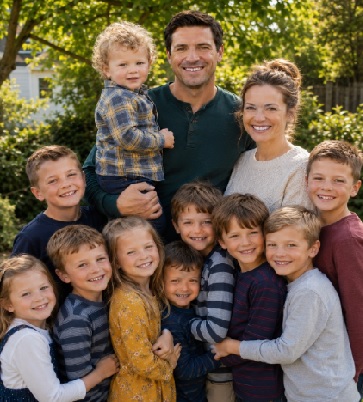
Claire had left behind ten children. They ranged from a toddler who could barely form complete sentences to a teenage girl old enough to understand that something terrible had happened but too young to know what to do with that knowledge.
I had been preparing to marry their mother.
I had never imagined becoming their only parent.
Yet within a matter of weeks, that was exactly what my life became.
A House That Suddenly Felt Too Large
Before Claire disappeared, our home had been noisy in the comforting way large families often are. Someone was always looking for a missing shoe, arguing about whose turn it was to wash the dishes, asking for help with homework, or opening the refrigerator five minutes before dinner.
Afterward, the same noises remained, but something underneath them had changed.
Every sound seemed to exist around an empty space.
The younger children asked when their mother would return. At first, I answered carefully.
“I don’t know.”
Then came the harder questions.
“Is Mom lost?”
“Can the police find her?”
“Does she know where we are?”
There were no good answers.
I learned quickly that grief does not arrive in an orderly fashion, especially in children. One would cry openly while another seemed perfectly fine for weeks. One became angry. Another stopped talking about Claire entirely. A third started sleeping with one of her sweaters.
And then there was Emma, the oldest.
She was fifteen when her mother disappeared.
Unlike the others, she rarely asked questions.
That should have worried me more than it did.
But at the time, I mistook silence for strength.
Becoming Their Father
Technically, I had not yet become Claire’s husband when she vanished. Emotionally, however, the distinction meant very little to the children or to me.
I had already been part of their lives. I knew their teachers, their favorite meals, their birthdays and their habits. I knew which child hated thunderstorms and which one pretended not to be afraid of the dark.
So I stayed.
There were legal complications, family discussions, paperwork and difficult decisions. Nothing about keeping ten siblings together was simple. But separating them after they had already lost their mother seemed unbearable.
Eventually, the house developed a new rhythm.
Breakfast happened in shifts. Laundry became an operation requiring military discipline. A whiteboard in the kitchen contained school schedules, appointments, sports practices and reminders.
Money was often tight.
Privacy barely existed.
Sleep became something I remembered rather than something I regularly experienced.
But slowly, almost invisibly, we became a family again.
Not the family we had expected to be.
A different one.
The children began calling me Dad naturally. I never asked them to. The first time it happened, I was fixing a bicycle in the driveway.
“Dad, can you help me?”
The word passed so casually that the child who said it probably never realized what it did to me.
I had to pretend I was still concentrating on the bicycle.
The Question I Could Never Answer
As the years passed, Claire’s disappearance stopped dominating every conversation, but it never truly left our home.
Her photographs remained on the walls.
We celebrated her birthday quietly.
Sometimes the younger children asked me to tell stories about her.
I always chose the good ones.
How she once burned dinner so badly that we ordered pizza and ate it on the kitchen floor.
How she sang terribly but confidently.
How she could recognize which child was coming downstairs simply from the sound of their footsteps.
What I did not discuss was the river.
Officially, Claire remained missing.
The investigation had produced possibilities but no definitive explanation. There was no confirmed account of what happened after she left home that night, and without clear evidence, speculation was all anyone had.
Some believed she had suffered an accident.
Others quietly wondered whether she had deliberately disappeared.
I hated that theory.
I could not reconcile it with the woman I knew. Claire loved her children fiercely. Whatever problems she might have faced, abandoning ten children without explanation seemed impossible.
Still, uncertainty has a way of attacking confidence.
During sleepless nights, I sometimes wondered whether I had misunderstood the person I planned to marry.
Then I would feel ashamed for wondering.
Emma Never Forgot
By the seventh year, the children were older and our lives had changed dramatically.
The toddler who once asked whether the police could bring Mommy home barely remembered her.
The middle children had developed lives filled with friends, school and plans for the future.
Emma was twenty-two.
She had become independent, serious and unusually protective of her younger siblings.
There was something else about her too.
Whenever Claire’s disappearance came up, Emma became distant.
I had noticed it before, but grief can explain almost any strange behavior. I assumed she simply remembered more than the others.
One evening, after everyone else had gone to bed or disappeared into their rooms, I found Emma sitting alone at the kitchen table.
She wasn’t using her phone.
She wasn’t reading.
She was simply sitting there with both hands wrapped around a cup that had long since stopped steaming.
“Everything okay?” I asked.
She looked at me.
“No.”
There was something in her expression that immediately made me sit down.
For several seconds, neither of us spoke.
Then she asked a question I had never expected.
“Do you remember the last night Mom was here?”
Of course I remembered.
I remembered almost every detail.
The time.
The weather.
The clothes Claire had been wearing.
The final conversation we had.
The police arriving.
The phone calls.
The river.
“Yes,” I said.
Emma lowered her eyes.
“I remember it too.”
That did not surprise me.
What came next did.
“I never told the police everything.”
Seven Years of Silence
My first reaction was disbelief.
Emma had been questioned after Claire disappeared. Everyone in the household had been questioned. Investigators had carefully reconstructed the hours leading up to the disappearance.
“What do you mean?”
She began rubbing her thumb against the side of the cup.
“I was scared.”
“Scared of what?”
She did not answer immediately.
Then she said something that made the room seem suddenly smaller.
“Someone came to see Mom that night.”
I stared at her.
The police investigation had focused heavily on Claire’s movements after leaving the house. As far as I knew, nobody had ever established that an unexpected visitor had appeared beforehand.
“Who?”
Emma swallowed.
“I didn’t know him.”
“Did you see his face?”
She nodded.
That was when I realized this was not a vague childhood memory.
Emma remembered.
She had carried something with her for seven years.
I tried to remain calm.
“What happened?”
“He and Mom argued.”
“About what?”
“I couldn’t hear everything.”
She paused.
“But I heard my name.”
That frightened me more than anything she had said so far.
“Your name?”
Emma nodded.
“And I heard Mom tell him he had to leave us alone.”
Memory Is Not Evidence
I wanted to demand every detail immediately, but I knew that memory, especially a memory formed during a traumatic event, can be complicated.
People can remember emotional moments vividly while misremembering timing, sequence or exact words. Seven years can blur details further.
So I asked Emma to tell me only what she genuinely remembered.
No guessing.
No filling in gaps.
She described hearing voices downstairs after she was supposed to be asleep. She had walked into the hallway and listened from the staircase.
Claire was speaking to a man.
The conversation was tense.
Emma could not remember every sentence, but she remembered her mother sounding frightened.
Then the front door opened.
The man left.
Claire remained inside for several minutes.
Later, she left too.
That was the last time Emma saw her mother.
“Why didn’t you tell anyone?” I asked.
Emma’s eyes filled with tears.
“Because he saw me.”
I felt cold.
“When?”
“When he was leaving.”
She explained that she had been standing partly hidden at the top of the staircase. As the stranger reached the door, he looked upward.
Their eyes met.
The next day, while the family was already panicking over Claire’s disappearance, Emma received a message.
She no longer had the phone.
The number had been unfamiliar.
But she remembered the meaning of the message clearly.
Stay quiet.
She was fifteen years old.
Her mother was missing.
And someone she did not know apparently knew that she had witnessed his visit.
So she obeyed.
The Burden Children Carry
I wanted to ask why she had not trusted me.
But the moment I looked at her, I understood how unfair that question would have been.
Adults often imagine children processing danger the way adults do.
They don’t.
A frightened fifteen-year-old does not necessarily think about preserving evidence, identifying suspects or explaining threats to investigators. She thinks about surviving the next hour.
Emma had also been surrounded by nine younger siblings who were terrified of losing another person.
She had convinced herself that speaking might put them in danger.
Then days became weeks.
Weeks became months.
And the longer she remained silent, the harder confession became.
“What changed?” I asked.
“Why tell me now?”
She looked toward the hallway where photographs of the children covered the wall.
“Because they’re older now.”
Then she looked back at me.
“And because I found something.”
The Photograph
Emma left the kitchen and returned with an envelope.
Inside was an old photograph.
I recognized Claire immediately.
She looked younger, perhaps in her early twenties.
She was standing beside a man.
I had never seen him before.
At least, I didn’t think I had.
Emma pointed at him.
“That’s the man who came to the house.”
I examined the photograph again.
“Where did you find this?”
“In Mom’s things.”
We had kept several boxes containing Claire’s personal belongings. Over the years, some had been opened and reorganized, but others remained largely untouched.
Emma had recently begun sorting through them.
The photograph had been hidden inside an old book.
On the back was a date and a first name.
Nothing more.
It was not proof that the man had harmed Claire.
It was not proof that he had gone anywhere near the river.
It did not explain why Claire disappeared.
But for the first time in seven years, we had something concrete that connected an unknown visitor from that night to Claire’s earlier life.
And Emma could identify him.
The Past Was No Longer Finished
I placed the photograph on the kitchen table.
For years, I had taught the children that accepting uncertainty was part of surviving grief.
We could remember their mother without allowing unanswered questions to destroy our lives.
Now those unanswered questions had returned.
But they were different.
Before, we had only theories.
Now there was a witness who had never fully spoken.
There was a threat she had never reported.
There was a photograph.
There was a name.
I told Emma we would not investigate the man ourselves. If her memories and the photograph were potentially relevant, they needed to be given to the proper authorities. Trying to confront someone based on incomplete information could be dangerous and could interfere with any renewed investigation.
Emma nodded.
Then she began crying.
Not loudly.
It was the exhausted crying of someone finally putting down a weight she had carried far too long.
I moved beside her and held her.
“You should have told me,” she whispered.
“You were fifteen.”
“I was afraid.”
“I know.”
For seven years, I had thought my greatest responsibility was raising the ten children Claire left behind.
That night, I understood something else.
One of those children had been protecting the rest of us in the only way she knew how.
Outside, rain began tapping softly against the kitchen window.
The photograph remained between us on the table.
I looked again at the unfamiliar man standing beside the woman I had intended to marry.
For years, the central question had been simple:
What happened to Claire after she reached the river?
Now I wondered whether we had been asking the wrong question from the beginning.
Perhaps the real mystery had started hours earlier, inside our own house.
And for the first time in seven years, we had a reason to reopen the past.