The front door of the police station opened shortly after lunchtime, but no one behind the reception desk expected to see the family standing there.
A young father entered first, holding the door open for his wife. Between them walked their two-year-old daughter, Lily. She was clutching a small stuffed rabbit so tightly against her chest that its long ears were folded beneath her fingers.
Her face was red from crying.
The family did not look like people who had come to report a robbery or an accident. The parents seemed more confused than frightened, while their little daughter looked genuinely terrified.
Officer Daniel Harris looked up from his computer.
“How can I help you?”
The father hesitated.
“We were hoping someone could talk to our daughter.”
Harris looked at the little girl.
“To her?”
Her mother nodded.
“She says she has to tell the police something.”
Lily immediately buried her face in her mother’s coat.
During his years on the job, Daniel had encountered plenty of unusual situations, but this was certainly a new one.
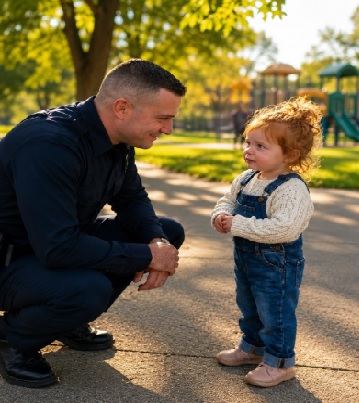
He stepped out from behind the desk and crouched down so he was closer to the child’s height.
“Hello,” he said gently. “My name is Daniel. What’s yours?”
There was no answer.
Her mother whispered:
“You can tell him.”
After several seconds, Lily finally looked at the officer.
“Lily.”
“That’s a beautiful name. And what’s your friend’s name?”
She lifted the stuffed rabbit slightly.
“Bunny.”
Daniel nodded seriously.
“Well, Lily and Bunny are both welcome here.”
For the first time since entering the station, the girl stopped crying.
But not for long.
Then she asked a question that made several nearby officers turn their heads.
“Are you going to put me in jail?”
Daniel blinked in surprise.
Her parents exchanged tired glances.
“No,” he replied. “Why would I put you in jail?”
The girl lowered her eyes.
“Because I did something bad.”
Now even the officers who had been pretending not to listen became curious.
Daniel pulled over a chair and sat down.
“Then why don’t you tell me what happened?”
Lily shook her head.
Apparently, whatever she believed she had done was too terrible to say out loud.
Her father tried to explain the situation.
The previous evening, the family had been watching television when a children’s program mentioned that police officers catch people who break rules. Recently, Lily had become fascinated with rules. In her two-year-old understanding of the world, rules were absolute.
You did not draw on walls.
You did not take things without permission.
You did not hit people.
And if you did something very bad, the police came.
Her parents had tried to reassure her that morning, but Lily refused to believe them.
She was convinced that she had committed a real crime.
And she had decided that she had to confess.
“What did she do?” Daniel quietly asked her parents.
Her mother smiled.
“She won’t tell us.”
That surprised him.
“You don’t know either?”
“No. She woke up upset this morning and kept saying she had to go to the police.”
Daniel looked at Lily again.
Suddenly, he realized that the situation really did matter—not because the child was actually in trouble, but because her fear was completely real to her.
Adults often forget how enormous small problems can seem to children. A broken cup can feel like a catastrophe. A disappointed expression on a parent’s face can feel like a terrible punishment. A simple warning from an adult can become an unbreakable law in a young child’s mind.
Daniel decided not to laugh at Lily or tell her that her worries were silly.
Instead, he placed a blank sheet of paper in front of her.
“Can you show me what happened?”
Lily stared at the paper.
Then she looked at her mother.
Her mother nodded encouragingly.
The girl picked up a pencil.
She drew several circles, a crooked line and something that vaguely resembled a person. Then she added a small square beside it.
Daniel studied the drawing with exaggerated seriousness.
“Is this your house?”
Lily nodded.
“And is this you?”
Another nod.
He pointed at the square.
“What’s this?”
Lily whispered something so quietly that he could not hear her.
“What did you say?”
“A cookie.”
Her father’s expression changed.
“A cookie?”
Lily’s lower lip began trembling again.
Daniel waited patiently.
Finally, the confession came.
“I took Daddy’s cookie.”
For several seconds, nobody said a word.
The nearby officers had expected almost anything except that.
Her father stared at her.
“My cookie?”
Lily nodded guiltily.
“The chocolate one?”
Another nod.
Then her father remembered.
The night before, he had left the last chocolate cookie from a box on a plate in the kitchen. When he came back later, it was gone. He had jokingly accused his wife of eating it, but she denied it.
Soon afterward, they both forgot about the little mystery.
Lily had not.
Apparently, she had wandered into the kitchen that evening, spotted the cookie and eaten it without asking permission.
Then she had overheard her parents discussing its disappearance.
In the mind of a two-year-old, the situation had gradually become something terrible.
She had taken something that belonged to someone else.
She had hidden the truth.
And police officers caught people who took things that did not belong to them.
By bedtime, Lily had apparently built an entire criminal case against herself in her imagination.
Daniel struggled not to smile.
“So you ate your father’s cookie without asking?”
“Yes.”
“And you knew it was his?”
“Yes.”
“And that’s why you came here?”
Lily nodded.
The room became quiet again, but this time the silence was not tense. It felt warm.
Daniel leaned slightly toward the girl.
“Lily, taking someone else’s cookie without permission isn’t a good thing to do.”
Her eyes widened.
“But people make mistakes sometimes.”
She listened carefully to every word.
“When we make a mistake, we should tell the truth, apologize and try not to do it again.”
Lily asked the question that mattered most to her.
“Jail?”
“No jail.”
The relief appeared on her face instantly.
Her shoulders relaxed. She stopped squeezing Bunny so tightly.
Then she turned toward her father.
“Sorry, Daddy.”
Her father crouched beside her.
“I forgive you.”
Lily wrapped both arms around his neck.
Several officers nearby smiled. One quickly returned to his desk before anyone noticed his reaction.
The story could have ended there, but Daniel had another idea.
He took a small sheet of paper and wrote a few words on it.
Across the top, in large letters, he wrote:
“COOKIE CASE — CLOSED.”
Underneath, he drew a large check mark.
Of course, Lily could not read yet, but she understood Daniel’s explanation.
“The case is over,” he told her. “You told the truth.”
She stared at the paper as if she were holding an official document of enormous importance.
“Finished?”
“Finished.”
Lily smiled.
Before leaving, she insisted on shaking Daniel’s hand. Then she made Bunny “shake” the officer’s hand too.
The family was already heading toward the exit when Lily suddenly stopped.
She turned around.
“Officer?”
“Yes?”
“I don’t take Daddy’s cookies anymore.”
Her father laughed.
“I think that’s a good rule.”
The door closed behind them.
Within minutes, the police station returned to its usual rhythm: phones ringing, keyboards clicking and officers walking through the corridors carrying paperwork.
But the encounter remained memorable.
There was certainly something funny about it. A two-year-old voluntarily turning herself in to the police because she had eaten a chocolate cookie was not the kind of story people easily forgot.
Yet beneath the humor was something much more meaningful.
Young children do not understand morality in the complicated way adults do. Their earliest ideas about right and wrong are shaped by the reactions of parents, teachers and other adults around them. Rules can seem incredibly strict because a child has not yet learned to distinguish between a small mistake and truly serious wrongdoing.
That is why the way adults respond matters so much.
Daniel could have laughed when he heard Lily’s confession. Her parents could simply have told her that she was being silly. Either response might have ended the conversation more quickly.
Instead, the adults treated her feelings seriously without making her fear worse.
Lily learned that taking something without permission was wrong. But she also learned something equally important: admitting a mistake does not always lead to punishment.
Sometimes it leads to forgiveness.
For a child, that lesson can be far more valuable than simply being told to behave.
Fear can make people hide the truth. Trust, on the other hand, can give them the courage to admit what happened.
Lily entered the police station convinced that one chocolate cookie was about to change her entire life.
She walked out holding her mother’s hand, carrying Bunny under her arm and proudly holding a piece of paper declaring that her imaginary case had officially been closed.
The cookie had disappeared the night before.
But the lesson the little girl learned could stay with her for much longer.