When my grandmother died, I thought grief might bring our family closer together, at least for a while. Instead, the opposite happened. Her house became a place where everyone seemed to think less about who she had been and more about what they might receive after her death.
Within days, relatives—some of whom had barely visited Grandma during the final years of her life—were discussing furniture, jewelry, savings, and anything else that might have value. Old resentments resurfaced one after another, and every cupboard or drawer seemed to become a reason for another argument.
I wanted no part of it.
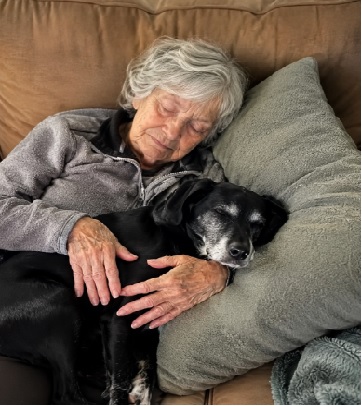
There was only one thing I cared about: Nuka, Grandma’s elderly dog.
He had spent almost his entire life by her side. He followed her from room to room, slept near her chair, and patiently waited outside the kitchen whenever she prepared dinner. After Grandma died, Nuka seemed completely lost. He wandered through the house as if he still expected her to appear at any moment.
But nobody wanted to take him.
“He’s already old,” one relative said.
“He’ll probably need constant veterinary care,” another added.
Someone even suggested taking him to a shelter.
That was when I made my decision.
“I’ll take Nuka.”
Nobody argued with me.
In fact, everyone seemed relieved.
The Only Inheritance I Wanted
Nuka arrived at my apartment with almost nothing: an old blanket, two bowls, half a bag of dog food, and the worn collar he had been wearing for years.
The first few days were difficult.
He barely ate. Whenever footsteps sounded in the hallway, Nuka immediately lifted his head and stared at the door. At night, he sometimes wandered around the apartment for a long time before finally settling beside the sofa.
I knew exactly who he was looking for.
Grandma.
Animals may understand death differently from humans, but they certainly recognize when someone important disappears. Familiar routines change, a familiar voice is suddenly gone, and the person who once represented safety is no longer there.
So I decided to give Nuka time.
I placed his old blanket beside my bed and tried to feed him at roughly the same times Grandma had. Gradually, he began adjusting to his new home.
Then, one evening, something strange happened.
Nuka had been scratching his neck repeatedly, so I removed his collar to make sure it wasn’t irritating his skin. The leather was old and soft, with several signs of repair. Apparently, Grandma had continued using it long after most people would have bought a new one.
As I ran my fingers along the inside of the collar, I suddenly felt something hard beneath the lining.
At first, I assumed that some metal part of the buckle had shifted.
But the hard object was nowhere near the buckle.
I pressed the spot again.
There was definitely something hidden inside.
Something Had Been Sewn Into the Collar
One section of stitching looked slightly different from the rest. It was carefully done, but the thread appeared newer.
I found a small pair of scissors and gently opened a few stitches.
A tiny object wrapped in plastic fell onto the table.
For several seconds, I simply stared at it.
Inside was a small brass key.
Beside it was a folded piece of paper.
My hands began to shake before I even opened it.
I recognized the handwriting immediately.
It was Grandma’s.
The note contained only one short sentence:
“If Nuka is with you, then I was right.”
I read those words again.
Then once more.
Suddenly, the dog sleeping peacefully beside my chair was no longer simply an unwanted animal I had taken from Grandma’s house.
Grandma had expected someone to take Nuka.
More importantly, it seemed she had hoped that person would be me.
But what did the key open?
There was no address, number, or explanation.
For the rest of the evening, I searched through my memories.
Grandma had owned dozens of keys. Some opened cupboards, others belonged to old locks that probably no longer existed, and several had been lying forgotten in kitchen drawers for years.
But this key was small.
Far too small for an ordinary door.
It looked like the kind of key used for a box or chest.
And then I remembered the wooden box.
The Box Nobody Could Open
For years, an old wooden box had been kept in the closet in Grandma’s bedroom.
I remembered seeing it when I was a child. It was made of dark wood, with worn corners and a small metal lock.
I had never known what was inside.
After Grandma’s death, several relatives had examined it while sorting through her belongings. Someone had even tried to open it, but no matching key could be found.
Because the box was surprisingly light, everyone eventually lost interest.
The following morning, I drove back to Grandma’s house.
Most of the valuable belongings had already been claimed or divided. The rooms looked strangely empty.
But the wooden box was still sitting inside the closet.
Nobody had wanted it.
I carried it into the kitchen, placed it on the table, and inserted the key into the lock.
It fit perfectly.
There was a quiet click.
For several seconds, I hesitated before lifting the lid.
After all the arguments in the family, I almost expected to find money or jewelry inside.
There was neither.
Instead, the box contained photographs, letters, and several notebooks.
At first, I was confused.
Then I started reading.
A Completely Different Kind of Treasure
The photographs covered decades of Grandma’s life.
Some showed her as a young woman. Others showed my grandfather, my mother, and relatives I knew only from old family stories.
There were photographs of me as well.
One showed my first birthday. Another captured a school performance. There was even a photograph from a summer I had almost completely forgotten.
Beneath the photographs were handwritten notebooks.
Grandma, I discovered, had spent years recording memories: ordinary days, family celebrations, difficult periods in her life, and observations about the people around her.
It wasn’t a traditional diary. Sometimes an entry consisted of only a few sentences.
But taken together, those pages represented something far more valuable than I had expected.
They had preserved her voice.
At the very bottom of the box was an envelope with my name on it.
This time, the letter was much longer.
Grandma wrote that during the final years of her life, she had carefully observed the people around her. She understood how possessions could change the behavior of relatives after someone died.
She also knew perfectly well that Nuka would become an inconvenience to many people once she was gone.
He was old. He required patience and care. Looking after him could become expensive.
And in return, he offered no financial reward.
That was precisely why Nuka became a kind of test.
Grandma believed that whoever willingly accepted responsibility for an elderly dog would probably also understand the true value of what she had preserved.
The wooden box contained no fortune.
It contained our family’s history.
Why Grandma Hid the Key
At first, the whole plan seemed unnecessarily complicated. Grandma could simply have given me the box while she was alive.
But the more I read her notes, the more I understood her decision.
She didn’t want the family archive to automatically go to someone simply because a name had been written in a document. She wanted it to reach someone capable of showing compassion when there was no obvious reward for doing so.
Nuka became her messenger.
Anyone could have taken him.
Nobody else did.
After realizing that, I began looking differently at the arguments that had followed Grandma’s funeral.
My relatives had spent hours discussing objects with obvious financial value while barely noticing the living creature who had depended entirely on Grandma.
Ironically, the one everyone considered a burden had been carrying the only key that truly mattered to me.
What Happened to the Family Archive
I didn’t keep the photographs hidden from my relatives forever.
After finishing Grandma’s notebooks, I began carefully organizing the archive. I copied some of the photographs and shared them with family members. Others helped us remember relatives whose names the younger generations barely knew.
But I treated the notebooks much more carefully.
They contained Grandma’s private observations, and I realized something important: not everything a person writes privately during their lifetime should automatically become public property after their death.
That became another lesson.
Inheritance is not only about the right to own something.
Sometimes it is also a responsibility.
Old photographs need to be preserved. Letters need context. Personal documents deserve respect and careful judgment.
Grandma had trusted someone to make those decisions.
I would never be able to ask whether she had planned every detail or had simply hoped that circumstances would unfold this way.
But the note hidden inside Nuka’s collar made one thing clear: it mattered deeply to her who would become the guardian of those memories.
Nuka’s Final Home
Nuka stayed with me.
Over time, his health did begin to decline, just as my relatives had predicted. There were visits to the veterinarian, medications, and sleepless nights when he struggled to rest.
But I never regretted my decision.
Gradually, Nuka stopped waiting beside the front door.
He learned where his food was kept, found his favorite corner of the apartment, and began following me from room to room—just as he had once followed Grandma.
Sometimes I wondered whether he had ever sensed that a secret was hidden inside his old collar.
Probably not.
To him, it had simply been the collar he had worn for years.
But to me, that worn piece of leather became forever connected to my final memories of Grandma.
When I bought Nuka a new, softer collar, I didn’t throw the old one away.
I placed the brass key back inside the wooden box.
What We Leave Behind
When people talk about inheritance, they usually think of money, property, jewelry, land, and other valuable possessions.
Of course, those things matter. Such an inheritance can provide financial security and sometimes even change a person’s life.
But material possessions are not the only things we leave behind.
An old handwritten recipe can bring back a childhood memory. A faded photograph can introduce grandchildren to relatives they never had the chance to meet. A letter can reveal an entirely unknown side of someone we thought we understood.
And sometimes an old dog can unexpectedly reveal something about an entire family.
When my relatives looked at Nuka, they saw future expenses, responsibility, and inconvenience.
I saw Grandma’s loyal companion sitting alone in a house, unable to understand why his familiar world had suddenly disappeared.
I didn’t take him because I expected a reward.
I took him because leaving him behind felt wrong.
Only later did I discover that Grandma had given that decision a completely different meaning.
Eventually, my relatives received the possessions they had argued over.
I received something whose value could never be measured in money: decades of memories, pieces of our family’s history, and one final message from someone who was no longer there.
And it all happened because I walked away from Grandma’s house with the only inheritance nobody else wanted.